
haiku tsurezure
haiku tsurezure - #42
LINIJE ŽIVOTA / LIFE LINES / 生命線
– a new book of haiku by Dejan Pavlinović (published by TONDAK, 2024)
Dejan Pavlinović
When I started writing haiku in 2007, I got hooked immediately. It took some time to get a grasp of all the nuances of this wonderful and unique poetical expression. However, time has passed, I’ve gained experience, and I’d like to believe I’ve refined myself in terms of content, style, and quality over the years. Meanwhile, I have published two solo haiku books (Down the Milky Way and Life Lines) and, together with Michael Dudley and Tomislav Maretić, one co-authored and co-created collection of haiku, senryu, haiku sequences and rengay (Nexus Haiku). Also, I’ve been fortunate to connect and interact with haiku poets from all over the world, which has been an invaluable experience, both poetically and personally.
My first solo collection DOWN THE MILKY WAY was published in 2016, and, among others, includes many poems inspired by parenthood and the birth and early years of my two sons, highlighting some lighter, perhaps more joyful moments of life compared with my second book.
down the Milky Way
a little finger (The 20th ITOEN „Oh-I-Ocha“ New Haiku Contest, Japan 2009 - Merit Award)
only for a moment
in a little hand (The 21st ITOEN „Oh-I-Ocha“ New Haiku Contest, Japan 2010. – Second prize, Tokusen)
from mother’s breast
nightly silence (A Hundred Gourds 5:2, March 2016)
My second solo collection LINIJE ŽIVOTA / LIFE LINES / 生命線 was published in 2024, and mostly features poems written after the publication of my first book. Life has a way of creating surprises, bringing both its ups and downs, so in the meantime, my brother, our families, and I went through a difficult period—the illness and eventual passing of both our parents. As a result, themes evoking parents, loss, and transience are subtly woven into this book. On the other hand, the book emphasizes the cyclical nature of life and celebrates it, along with all the beauty and joy it brings.
my aging hands
down father's ribs
父の骨の下に
わが老いた手 (Blo͞o Outlier Journal, Winter Issue 2020)
LIFE LINES is dedicated to my parents, and I think it was for me a way to reconcile and accept the loss of two wonderful people. By documenting through haiku the onset, progression of illness, physical decline, and ultimately their death, I believe this sort of intimate diary-like chronicle provided me with solace. At the same time, I guess, it offered a sense of objective detachment, making it easier to accept the reality and inevitability of their end.
how he left it behind
without his smell
どのように残したのだろうか
父の臭いもなく (The Betty Drevniok Award, Canada 2021 –2nd prize)
The concept and arrangement of the poems and chapters are inherently circular, reflecting the cyclical nature of things—beginnings, endings, and then beginnings again, and so forth. I aimed to achieve this sense of cyclicality through the overall composition and organization of the collection by arranging the poems in four chapters which follow the main cycles of life alluding first to birth, beginnings, and discovery; then youth and strength; followed by maturity and uncertainty; and finally, the last chapter, which hints at wisdom, calm, endings, and transience.
the sun
reshaping itself
自分の姿を再び作り出す
太陽 (Wales Haiku Journal, Summer 2020)
An important element in each of the chapters are three poems with a direct reference to my late parents and the illness that preceded their passing. These 12 poems essentially form a kind of fifth section, interwoven through all the chapters forming a thread that connects the entire collection.
a butterfly settles
on my coffee cup
蝶がじっとしている
わたしのコーヒーカップの上に (Autumn Moon Haiku Journal 5:2, Spring-Summer 2022)
these neighbouring names
have become familiar
墓地の隣人らの名前
おなじみさま (HAIKU KLUB Gimnazija Pula miscellany No.5, 2022)
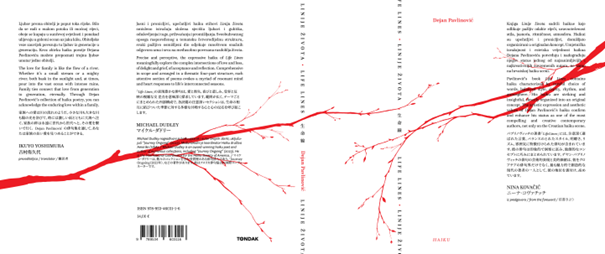
I was lucky and privileged to have great collaborators during the creation of this collection. The distinguished Croatian haiku poet Nina Kovačić wrote the foreword, and the book features blurbs by renowned Canadian poet Michael Dudley and Japanese poet Ikuyo Yoshimura, who also translated my poems into Japanese. Also, the look and feel of a book is very important to me. I believe the cover needs to portray the content, energy and essence of the book, and that’s why we put a lot of effort into the design and layout of the book. I was lucky to have collaborated with Matko Plovanić, who, I think, did an excellent job. His choice of paper and the texture of the cover, as well as the stunning cover design—where budding branches literally mirror the lines on my palm—are brilliant solutions. Even more so because they perfectly complement the content and concept within the covers, along with the calligraphy-like illustrations, drawn by Thierry Dubois, which introduce the reader each time to a new chapter and atmosphere in a remarkable way.
the song of cicadas
growing louder
騒がしくなる
蝉の声 (30th Samobor Haiku Meeting - miscellany 2023)
I write equally in both Croatian and English, so I am privileged to often consciously choose to write in one language or the other, depending on my mood and the rhythm of the words at that certain moment. This gives me the luxury of selecting my original language. In the process of translation, interesting things always happen—sometimes the translation turns out better than the original, leading to changes in the original itself. In any case, the act of creation of a poem is a symbiosis of both languages in my case.
speaking
in bee language
ミツバチ語で
お話し中 (A Little Iris Haiku Contest, Croatia 2019 - Honorable Mention)
寄り添って眠る
長い夜 (World Haiku Review - Winter 2021/22)
In 2017 I travelled to Japan with my family. A year earlier, I had published my first book DOWN THE MILKY WAY. For me personally, this journey was also a kind of pilgrimage because I took the opportunity to visit places connected to haiku heritage. I visited the graves of Matsuo Bashō and Yosa Buson, went to the Bashō Museum and saw some of the sites Bashō celebrated and described in his poems and travel writings. A connection between my new book LIFE LINES and my Japanese journey is the Japanese poetess and professor Ikuyo Yoshimura. We met in Kyoto, where we had a wonderful time together. We’ve remained good friends and stayed in touch, and she translated my poems for this collection into Japanese. With the Japanese translations I wanted to pay my respect and admiration to the home of haiku, and to reach a wider audience as well. Besides the content, the kanji characters also give the poems and book a beautiful visual touch.
the old monk gathers
new petals over again
古僧が集い
新たな花びら舞う (IRIS International No. 4, Smiles Under The Cherries - A haiku travelogue from Japan, 2018)
Haiku has a long and rich tradition in Croatia with a vibrant haiku community scattered in regional associations organizing regular haiku meetings and readings accompanied with printed and digital publications. Our haiku poets are very active and present in the haiku community, and if we take into consideration the quality of poems and the number of international awards and Croatian authors being published, then Croatia is ranking very high, which is quite remarkable concerning we are a country with less than 4 million people.
Haiku has for me become an integral part of my life. Paraphrasing the great Croatian haiku poet and scholar Vladimir Devidé, not a single day has passed without me writing, reading, or thinking about haiku. I always say that haiku, beyond the act of creating and writing, is a form of meditation for me. During the process of writing, refining verses, and translating, I completely disconnect and drift away. Haiku slows me down, calms the mind, sparks curiosity, and heightens awareness of details, peculiarities, beauty, and the truth in everything. It shifts one’s perspective, making the ordinary extraordinary and so wondrous. It influences one's relationship with oneself, others, and nature itself, and thus, haiku inevitably becomes a way of life.
Dejan Pavlinović
Pula, Croatia
 Dejan Pavlinović
Born in Pula, Croatia, in 1968, he spent part of his childhood in Rotterdam, the Netherlands. He is currently active as an English and German teacher, part-time tour guide, and member of the Pula indie band ‘The Chweger.’ He is a member of the editorial staff of the haiku magazine Iris and the founding editor of the haiku group Haiku HR on Facebook. He runs the Gimnazija Pula Haiku Club in his school and holds haiku workshops for students. He also serves as a judge for haiku competitions for children and adults. He first encountered haiku in 2007.